
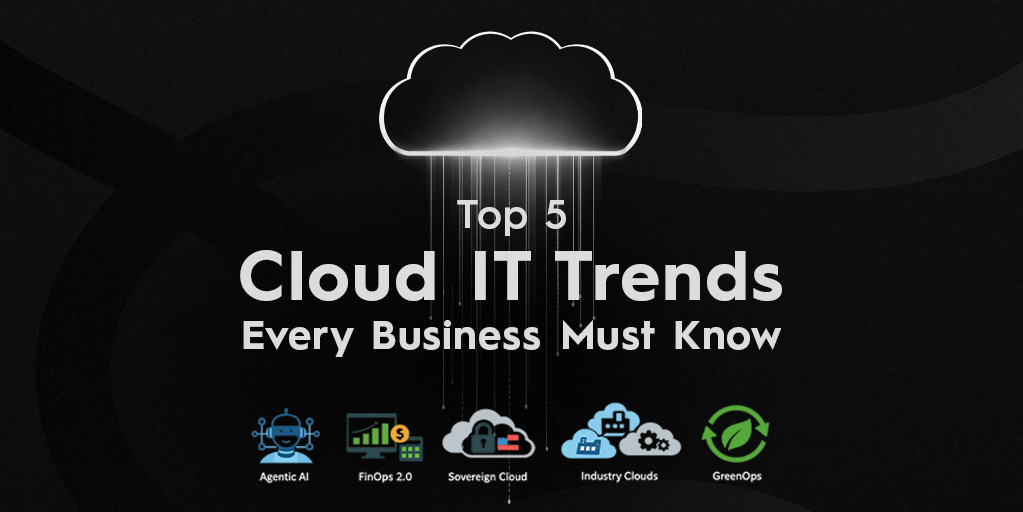
Top 5 Cloud IT Trends
Cloud computing enables businesses to run applications, store data, and manage IT systems over the internet. Instead of buying and maintaining heavy hardware, users can access computing resources anytime. Today, it plays a key role in helping companies become more flexible, scalable, and cost-efficient through modern cloud computing services and smart cloud solutions.
Cost efficiency: By eliminating the expensive hardware and maintenance, it helps reduce the cost
Flexibility: You can adjust your resources and tools at any time based on your needs.
Grow instantly: Businesses can easily scale back at any time when things slow down
Key Trends Transforming Modern Cloud Computing
1. Agentic AI
Agentic AI is designed to achieve a specific goal autonomously. The traditional AI works according to user prompts, while agentic AI can complete the goal by planning, using tools, and correcting its own mistakes.
How it works:
Analyzes Data: First, the system looks at all the information to understand exactly what is happening.
Plans Actions: After analyzing the data, it chose the best possible way to achieve the goal
Works Independently: Once the plan is ready, it accomplishes each task itself without any human intervention
Uses AI Workflow Automation: It reduces human errors and improves overall performance by using AI workflow automation
Learns from Outcomes: The best part? It continuously improves by learning from outcomes and getting better every time it works.
2. FinOps 2.0
FinOps 2.0 helps to take control of your cloud costs more effectively, with AI-driven automation and real-time data. It provides a clear cost report, which helps finance and IT teams work together to manage and optimize cloud costs.
How It Works:
- It effectively monitors your cloud spending to deliver clear visibility into your cloud cost management
- Optimizes Resources: You only provide the payment for what you actually use, as it uses the smart insight to reduce waste.
- Automates Cost Control: The system uses automation to adjust your resources instantly based on your actual needs.
- Improves Planning: It helps businesses accurately predict and manage future cloud costs.
3. Sovereign Cloud
A sovereign cloud is a cloud computing architecture that processes and stores your data within a specific country or regional borders. Securing data under the sovereign cloud protects a company from foreign surveillance laws.
In every organization, protecting and maintaining data is more important. The industries like
finance, healthcare, and government, choosing the Sovereign Cloud to protect the data is more effective.
How It Works
- Local Data Storage: Information is stored in regional data centers within the country.
- Regulatory Compliance: Meet local laws and data protection regulations.
- Controlled Access: It secures your information by localised regional policies
- Enhanced Security: Provides a more secure cloud environment for sensitive data.
4. Industry Clouds
Industry clouds are industry-specific cloud platforms designed to meet the unique needs of particular sectors like healthcare, BFSI, and manufacturing. Instead of building solutions from scratch, businesses can use these pre-configured cloud platforms that already include the tools, features, and compliance requirements needed for their industry.
These vertical cloud solutions help organizations adopt cloud technologies faster while ensuring they meet industry standards and regulations.
How It Works
- Pre-Built Solutions: Comes with ready-to-use features tailored for specific industries, reducing setup time.
- Industry Compliance: Supports regulatory requirements, making it easier to manage sensitive data securely.
- Customizable Platforms: Allows businesses to adapt the cloud environment based on their specific needs.
- Integrated Tools: Includes applications and services designed for workflows like healthcare data management or financial operations.
GreenOps
GreenOps is a cloud strategy focused on making cloud use more sustainable and energy-efficient. As businesses rely more on cloud infrastructure, managing the environmental impact of these operations has become increasingly important.
By adopting sustainable cloud computing practices, organizations can reduce their carbon footprint while still maintaining performance and cost efficiency.
How It Works
- Carbon-Aware Workload Scheduling: Runs workloads at times or in regions where energy usage has a lower carbon impact.
- Energy-Efficient Resource Usage: Optimizes cloud resources to avoid unnecessary energy consumption.
- Monitoring and Optimization: Tracks energy usage and identifies ways to improve efficiency.
- Smart Infrastructure Choices: Uses cloud providers and data centers that focus on renewable energy and sustainability.
Cloud Security and Zero Trust
Cloud security has evolved a lot and it is not the same as it was before. For years, organizations built walls around their systems and assumed anything inside was safe. But as more work moved to the cloud, those walls no longer made sense – there was no longer an “inside”.
That’s where Zero Trust enters the picture. The concept is simple but effective: never trust anyone by default. It doesn’t matter if you are an employee logging in at the office or a device that is already in the network.
The access request is checked, without fail. Accessing privileges are also strictly attached to actual necessity, with no access granted beyond what is necessary.
Combine the two – cloud security and Zero Trust – and there’s a configuration that fits the real world. One that assumes things will go wrong, isolates threats to contain the damage, protects data wherever it travels, and only grants access to authorized users.
Why This Really Matters in 2026
Why is this the case, you ask? Attackers are now using AI to orchestrate more intelligent, quicker, and more convincing attacks. 82% of companies are transacting and storing data on multiple clouds at the same time, meaning there is no single perimeter to protect.
Bots, automated tools, and AI agents are now targeted in addition to human accounts. Attackers in the current era target identities, APIs, and pipelines, rather than just networks. Zero Trust is not an option in such a setting. It’s the baseline.
The future of cloud computing
The future of cloud computing is centered on smarter, more flexible, and efficient solutions that help businesses grow faster in a digital-first world. With the rise of advanced cloud technologies, organizations are increasingly adopting cloud computing services that go beyond basic storage to support automation, AI, and real-time data processing. Trends like hybrid cloud computing and multi-cloud strategies are giving businesses greater control and scalability, while emerging cloud technologies such as edge computing are improving performance and speed. At the same time, evolving cloud security trends are ensuring stronger data protection and compliance. Overall, the future of cloud computing will enable businesses to innovate, optimize costs, and stay competitive by leveraging smarter and more adaptive cloud solutions.